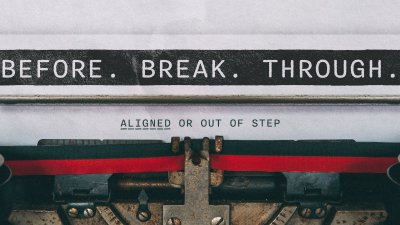
This powerful message centers on three transformative words: Before, Break, and Through. Drawing from Exodus 23, Numbers 14, and Mark 2, we're reminded that God goes before us, preparing our deliverance even while we're still in bondage. The Israelites' journey teaches us a sobering lesson about fear's destructive power. Despite God's promise to drive out their enemies gradually and give them the Promised Land, fear caused them to misalign with God's leading. They saw themselves as grasshoppers in the eyes of giants and chose to believe the obstacle over the promise. This misalignment wasn't dramatic—just a slight deviation—but like an arrow slightly off course, it caused them to miss their destination entirely. Fear doesn't need us to backslide completely; it just needs us to step slightly out of alignment with God's plan. The contrast comes through the paralyzed man whose friends tore through a roof to get him to Jesus. While fear breaks our alignment, faith pushes through every obstacle into God's presence. We're challenged to examine our own lives: Are we stuck in our pain, missing the ever-expanding kingdom of God because we've chosen to plant our feet in our problems? God's kingdom is constantly moving forward, but our pain can become our prison if we let it. The invitation is clear—push through into His presence, refuse to let fear speak the final word, and align ourselves with the God who has already prepared our breakthrough.
Epistles for Everyday Living
April 21, 2026
It's a Hook Moment
April 19, 2026 • Pastor Philip Spellman
4-14-26
How I Shows Up
April 7, 2026 • Pastor Philip Spellman
Risen NOT Removed
April 5, 2026 • Pastor Philip Spellman
The Anatomy of The I
How Did it Happen?
March 29, 2026 • Pastor Philip Spellman
This powerful exploration of the Parable of the Sower from Luke 8 challenges a common misconception many of us hold: that fruitfulness in our spiritual lives requires perfect circumstances. The message cuts straight to the heart of why the same Word of God produces different results in different people. It's not about the quality of the seed—God's Word is always good and powerful. It's not about whether we hear the message—all the ground receives seed. The determining factor is the condition of our hearts and our willingness to persevere. We discover that good ground isn't soil without rocks, weeds, or challenges. Rather, good ground is defined by its reception and perseverance regarding the Word. The key insight is profound: fruitfulness doesn't show up in perfect lives, but in resilient hearts. Those who bear lasting, visible, multiplying fruit are not those without trials, but those who refuse to let go of God's Word no matter what circumstances they face. This message invites us to examine whether we've been waiting for perfect conditions before we can be fruitful, or whether we're willing to hold tightly to God's promises right in the middle of our messy, difficult, imperfect lives. The call is clear: we can produce fruit right where we are today, if we simply refuse to surrender our grip on the Word of God.
The Great Displacement
March 24, 2026 • Pastor Philip Spellman
Press Through It
March 22, 2026 • Rev. Michael Robinson
This powerful message challenges us to understand that our walk with God isn't meant to be effortless—it requires us to press through valleys even after experiencing mountaintop moments. Drawing from Matthew 17's transfiguration account, we see Peter, James, and John witnessing Christ's glory alongside Moses and Elijah, yet immediately after this supernatural encounter, they descend to face a father's desperate plea for his demon-possessed son. The disciples had failed to deliver the boy, revealing a profound truth: yesterday's victory doesn't guarantee today's breakthrough. We can't build permanent tabernacles in God's presence and stay there—we must carry that anointing down into the valleys where people are hurting. The message confronts our tendency to measure spiritual success by mountaintop experiences while avoiding the reality that our character is forged in low places. Like the woman with the issue of blood who pressed through the crowd to touch Jesus' garment, or the Syrophoenician woman who humbly accepted even the crumbs from the Master's table, we must learn to approach God with desperation and humility. Our valleys aren't punishment—they're opportunities for God to demonstrate His power through our weakness. When we're in our lowest moments, dealing with financial pressure, health scares, or mental battles, we're actually positioned for breakthrough because the enemy only fights hardest when we're closest to victory. The call is clear: press through your mess, because someone's deliverance depends on you carrying God's presence into your workplace, neighborhood, and everyday life.
This powerful message takes us deep into the heart of what it means to offer a sacrifice of praise, drawing from the remarkable account in 2 Chronicles 20 where King Jehoshaphat faced an overwhelming enemy. Instead of leading with his strongest warriors, he sent the praise team to the front lines. What seems like foolishness becomes divine strategy as God responds to their worship by causing the enemy armies to turn on each other. We discover that praise is not merely a Sunday ritual or a warm-up to the sermon, but a spiritual weapon that displaces fear, worry, and doubt from our lives. The message challenges us to understand that praise is not about manipulating God to show up—He is already present—but about shifting our focus from our problems to His power. When Paul and Silas praised in prison, the earth shook and chains fell, not just for them but for everyone around them. This teaches us that our praise has ripple effects beyond our own circumstances. The core revelation is this: we cannot worry and praise simultaneously. Praise acts as a displacement, pushing out the poison of anxiety and filling us with peace. We are invited to stop waiting for the perfect circumstances to praise and instead praise our way into the right perspective, recognizing that God is working more on what is happening inside us than what is happening around us.
Epistles for Everyday Living
March 3, 2026 • Pastor Philip Spellman
Clean Your Plate
March 1, 2026 • Pastor Philip Spellman
Experiencing the Miraculous
February 22, 2026 • Evangelist David Smith • Mark 2:3–12, John 3:5, Matthew 28:19, Acts 2:38
Drawing from the biblical account in Mark 2 and 3, this message reveals how Jesus's miracles are always an answer to prayer. The speaker emphasizes that God loves to bless, touch, and heal his people, asserting that anything is possible through faith. He challenges the notion that miracles don't happen just because one hasn't seen them, highlighting God's unchanging nature as a healer and miracle worker. Through powerful testimonies of blind seeing, crippled walking, and tumors disappearing, the speaker illustrates God's active presence today. Can God touch you today? Can God heal you today? Can God bless you today? This message invites you to believe that God can abundantly satisfy whatever you need, right here, right now.
The Maker Above the Mountains
February 15, 2026 • Pastor Philip Spellman
In this sermon, we explore Psalm 121, revealing that the line "I will lift up my eyes to the hills, from whence cometh my help?" is not a statement, but a profound question. The psalmist challenges us to discern between the allure of false idols and worldly distractions found on "the hills" and the true, unwavering source of divine assistance. Discover how this ancient text guides us to focus our devotion and trust on the Creator, not the creation, ensuring our help comes from the Lord who made heaven and earth. Learn to navigate life's journey by recognizing where true fulfillment and protection reside.
Epistles for Everyday Living
February 10, 2026 • Pastor Philip Spellman
Let Me Remind you
February 8, 2026 • Pastor Philip Spellman
The ancient practice of the peace offering in Leviticus reveals God's enduring desire for communion with humanity. This offering, unlike others, was not solely for atonement but for fellowship, a shared meal in God's presence. This principle finds its ultimate fulfillment in Jesus, who became the perfect sacrifice, establishing an eternal relationship with God. His act covers all sin, inviting us to His table regardless of our imperfections.
Many feel unworthy or separated from God due to past mistakes or current struggles. This message reminds us that God's love precedes our perfection.
Discover how to embrace this profound invitation to continuous communion and allow His power to transform your life.
Epistles for Everyday Living
February 3, 2026 • Pastor Philip Spellman
In this insightful lesson from 1 Timothy, we explore the profound truth that training for godliness holds far greater value than physical exercise. While physical training offers temporary benefits, godliness yields rewards that extend beyond this life, promising quality of life both now and in eternity.
Discover how a deep relationship with God calls us to nearness and imitation, not just rigid rules. Learn why the Word of God, not our feelings or impressions, serves as the ultimate authority for discerning truth. Understand how to navigate opposition and criticism by living a consistent, godly life that speaks louder than any accusation.